
landscaping with azaleas (1 of 2)
principles
| elements
| other aspects
|| related pages
What is it that is pleasing about Monet's paintings of his garden, and artistic photographs of garden settings in books, magazines and calendars? They feature the principles and elements of design, which have evolved over centuries of art and gardening activities. These principles and elements can be used in planning, planting and maintaining landscapes.
Landscaping is influenced greatly by climate, cold hardiness and heat-tolerant zones; duration of seasons; type of soil; availability of water from rainfall or irrigation; sunlight or shade; contours of the land; size of the lot, buildings and other architectural structures; trees and natural flora; flowing water and ponds; budget; effort; and personal themes. These situations and characteristics control to a great extent what can be grown on the land and effective use of plants.
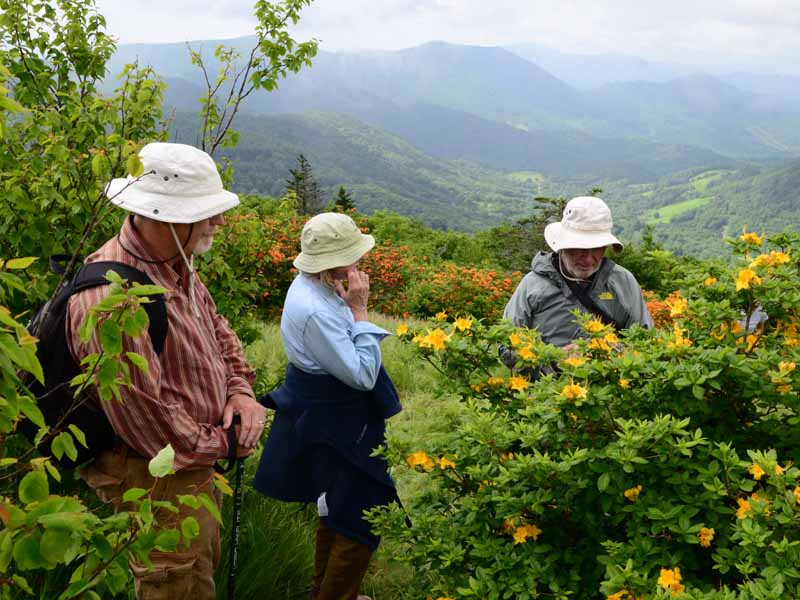
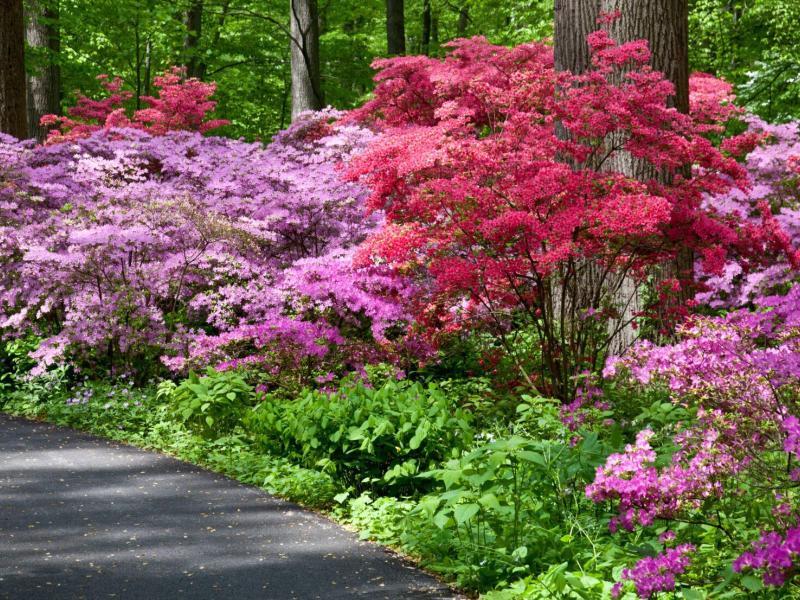
Azaleas can be used in many ways in landscapes. They can function as specimen plants or focal points, frames for focal points, settings around a tree or among groups of trees, foundation planting, hedges, screens, reflections from pools, background for other plants, and container plants. They can be placed in borders and beds, mulch islands, rock gardens, and woodland settings and along paths and driveways. They function in combination with other woody and companion plants. Azaleas because of their varied characteristics of plant size, forms, flower colors and bloom times are more versatile than other shrubs.
principles of design
Whatever the features and themes of a landscape, employ the principles of design and composition (e.g., scale and proportion, balance, gradation, rhythm, harmony, simplicity, variety or contrast, dominance and emphasis, and unity). Some of the principles may appear to be contradictory, but they are complementary and often interrelated. All of the principles do not have to be applied to every part of a landscape design. Personal themes dictate which are emphasized. Therefore, multiple answers to landscape design exists.
Scale and proportion Scale means size of an object in relation to what is considered as "normal" size. Proportion refers to size relationships between the relative size of an object, group of objects, or one part of a landscape to another and in relationship to their surroundings. They are crucial in landscaping. Plants and garden structures should be consistent with the style of the house and surrounding environment. Typically, mature trees and building architecture determine the scale for plants. For example, low plants are appropriate for single story houses, and larger plants are applicable for two-story houses. Large plants in a small lot or garden may appear out of scale, and small plants may become lost in a large lot.
Scale of individual plants considers low, medium and tall heights and narrow and wide dimensions. Different varieties of azaleas can function in various ways. For example, dwarf (under 18 inches high) azalea cultivars (e.g., North Tisbury hybrids) are useful in foregrounds, in rock gardens, in borders and along paths. Low (1-1/2 to 3 feet) azalea cultivars (e.g., typically, Robin Hill, Linwood, and Satsuki hybrids) are useful as foundation plants. They can be placed in front of medium-size (3 to 6 feet) cultivars (e.g., many Glenn Dale hybrids), and them in front of taller cultivars to provide depth. Tall (over 6 feet) cultivars (e.g., Southern Indian hybrids) will form walls, but they are useful as backgrounds or as screens for privacy. Tall rhododendrons and azaleas ought to be used in woodland gardens. Plants constantly grow and change in scale, so either locate plants with mature size in mind, or anticipate maintenance, pruning, and transplanting as future activities.
Balance Balance is equilibrium between different elements of a landscape. Arrangements around a focal or central point, line of vision (which may be a door, path, driveway, plot of grass, grouping of plants), or an architectural feature need to be balanced by visual weights or mass (i.e., apparent heaviness or lightness) of the elements. Arrangements can be either symmetric (e.g., mirror images or elements arranged evenly on each side) or asymmetric by having each side different but visually balanced. For example, a tall tree or tall group of plants on one side can be counter balanced with a low, spreading or mass of small plants on the other side, but with equal or nearly equal visual weights. Adjustments are made by reducing or enlarging or shifting location of the counterweights. Symmetry gives a sense of stability and a formal effect. Asymmetry gives a suggestion of motion and is dynamic. Plants grow asymmetrically in nature, and asymmetrical arrangement implies informality, and this is typical of today's architectural style. Distribution of shapes and masses is a function of balance. Balancing factors include equal attraction of large and small forms, light and dark values, bright and dull color intensities, coarse and fine textures, and/or dense and open areas. For example, two or more small plants can balance a larger one. A smaller dark plant can balance a larger light one. Thus, balance is concerned with creating a center of interest or focal point and its surroundings that will not disrupt unity of the whole or overwhelm other elements.
Gradation (i.e., sequence and transition) Sequence is the arrangement and blending of plants to give gradual transition from one area to another and to a focal point so as to not break visual flow. This also gives a feeling of movement. A good sequence is where one element (e.g., texture, color, form) changes at a time. For example, sequence can be enhanced by using large-leaf plants (e.g., rhododendrons) sparingly and increase the area of each successive plant group (e.g., camellias then azaleas) as leaves get smaller. Sequence is created by using elements that visually guide people smoothly through a garden. Each part of the landscape should relate to other parts through recognizable transitional patterns of color, texture, and/or form.
There is also bloom sequence to consider. The sequence of bloom times for native azaleas is R. canescens, R. austrinum, R. alabamense, R. vaseyi, R. periclymenoides, R. flammeum, R. calendulaceum, R. atlanticum, R. cumberlandense, R. arborescens, R. viscosum and R. prunifolium. The sequence of bloom times for evergreen hybrid groups is early Glenn Dale, Kurume, Southern Indian, mid-season (most) Glenn Dale, Back Acre, Robin Hill, late Glenn Dale, Satsuki, and second blooming of Encore. By selective planting of evergreen and native azaleas, there can be blooming azaleas for 7 to 9 consecutive months.
Rhythm Landscaping design, as with music, involves ordered regularity of the elements. Visual rhythm depends on repetition of accented elements. For example, repeated use of plants, lines, patterns, shapes, textures or colors throughout a garden creates rhythm and leads the eye from one area to the next, which gives a sense of movement. Three or more plants equally spaced in patterns give a cadence to rhythm. Repeating the same plants closely together tends to quicken rhythm and spacing them farther apart slows it down. A dominant color theme with counter points of contrasting colors also creates movement. Views can give a sense of the rhythm.
Harmony Harmony is the relationship of similar elements. Blending together of comparable plants, hues, tints, shades, textures, forms, shapes, sizes, materials and structures create harmony. This can be done by monochromatic or analogous colors that share a hue and by small transitions of colors (e.g., white with pink flush, to light pink, to medium pink, to deep pink, to maroon). The overall composition of forms (shapes and sizes), colors (e.g., hues, values, intensity) and textures should be harmonious, which helps create unity.
Simplicity Simplicity is another factor of unity. It implies restraint, which may be difficult for azalea collectors and plant lovers. An understanding of what is and is not important in design and omitting those that are unimportant is the key to simplicity. Limiting plant species is one approach (e.g., azaleas and plants that enhance and complement them) and repeat them. Too many contrasting elements (e.g., colors, textures and forms) lead to confusion and to loss of unity. Additionally, a simple landscape usually has low maintenance.
Variety or contrast Oversimplification, however, can be boring, and some variety is needed. Variety is difference, with the mixing of forms, textures, colors and plant species or cultivars creating combinations that are exciting without sacrificing simplicity of design. Attention and impact can be created by dynamic contrasts of lines, shapes, textures or colors, which attract attention and generate movement. For example, where horizontal plantings dominate, add vertical forms. Where there are analogous colors, add a flicker of complementary or intense color. Combine azaleas with rhododendrons and other companion plants to add interest, forms and textures and to extend bloom times. This results in variety, which is at the opposite end of a spectrum with unity. Too much variety, however, creates a perception of confusion.
Emphasis and dominance Emphasis is the major component that highlights the landscape. Emphasis can be done by placement in groupings, by isolation, by content of interesting plants and by contrast. Masses or broad sweeps of plantings accentuate color, form or texture. Plants for emphasis and their frames can highlight the primary focal point and lead a viewer's eyes around the garden.
A landscape should have a central subject or concentration (i.e., dominance) of an element or elements and space that draws the eye and attracts attention. This is a focal point. It may be a structure (e.g., fountain, statue, gazebo), a specimen plant, or a group of plants, that is of interest and presents a picturesque view. It can be located at the center of symmetry groupings or placed off the center where plant groupings or space lead the eye to it, and where it stands out from the surroundings. This can be done by a bold impact, by framing or by directing the eye with lines. A specimen plant should be placed far enough from other plants to allow development of its natural shape. Characteristics of focal points are bright or intense color, contrast in tonal value, concentration of detail, hard edges, gap or abnormalcies in a pattern and intersections. Focal points in paintings and photographs are often located a third of the way from the top or bottom and a third of the way from one side of a scene (i.e., rule of thirds). Focal points directed from anticipated viewing sites enhance a landscape setting. Focal points, however, should be used sparingly because they dominate, and too many appear busy and can detract from the overall landscape design.
An accent plant is more subtle than a specimen, and it draws attention to itself (due to its form, texture, color or unique features) by contrasting with its surroundings. For example, it is a featured plant in a grouping of plants, and it adds variety and depth to a composition and emphasizes its location.
Frames set a picture apart from a wall and harmonize with the picture by picking up some feeling, color or texture in the artwork. In landscapes, a focal point or center of interest ought to be framed. Framing plants should be distinct from that of the focal point (that is in height, foliage color, texture, shape or flower color) and be pleasing companions and look good against the background. Camera viewfinders or cardboard cutout frames can be useful in choosing focal points and locations for frames, using the rule of thirds. One way of framing a focal point is to set a second type of plant all around it. Such an arrangement will look good from all angles. Otherwise, the second plant can be set only to the right and left of the focal point; the flanking plants call attention to what is between them. Shorter second plants can be set only in front of the focal point; these underline it. Taller second plants can be set behind the focal point as a backdrop. Consider leaf color, contrasting colors, and secondary colors for framing. Cool colors can frame warm colored focal points. Evergreen archways, pairs of trees as sentinels, arbors, walls, hedges, and windows in fences can serve as frames. Several different plants can make up a frame. If this is done, there should be a pattern of similar shapes, textures or colors, around, on each side of, in front of or behind the focal point. There can be multiple frames of a focal point. Windows and doorways inside a house or outdoor structure serve as frames for indoor views of outdoor scenes. Frame views whenever feasible.
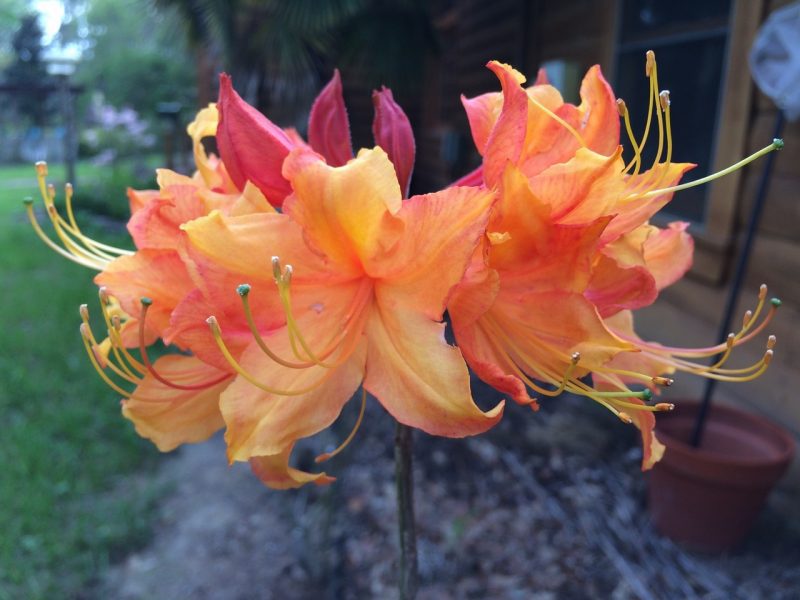
Selected cultivars of azaleas can function as focal points, accents or frames. Tall, shapely or brightly colored azaleas can be focal points or accents. Strategically located trees and shrubs (including azaleas) can serve as frames for them.
Unity Unity is a sense of oneness. The ultimate aim of landscape design is to have all parts relate to each other, to the whole landscape and to the environment. The various elements link together. There should be a sense of flow from one part to the other. Repetition of plant material, colors and patterns throughout is an important way to attain this. Without unity, a garden looks cluttered, jumbled, chaotic, unfocused and unplanned. Unity is the way the entire design comes together, is harmonious, and forms an aesthetically pleasing landscape.
related pages
azaleas
|