
Society
     Home
     About Us
     Join Us
     Conventions
     Research

    Azaleas
     Azaleas
     FAQ
     Pictures
     Ask Us
     Archives
     Sources
     Seed

    Other
     Links
     Gardens
     Online Store
     The Azalean
     Azalea City

    Website
     Site Map
     What's New

   search azaleas.org
  
   Google
.
green ASA logo with pink azalea
  landscaping with azaleas (2 of 2)        principles | elements | other aspects || related pages


  elements of design
Elements of design are used in each applicable principle. The elements include line, form, color, texture, space, time and motion. Consider their uses in works of art.

Line   Lines, which may be visible or implied, define spaces, areas or edges, and they direct the eye and may suggest movement. They can be vertical, horizontal, straight, angles of various degrees, curves, or concentric circles. Rectangles and squares define areas and can extend or reflect straight architectural lines of a house. There are, however, few straight lines in nature; therefore, consider using curves, which present strong contrast to lines of a house and provide interest. Long curves accent space. A smooth curving line will lead the eye gently along its length and create a soothing effect. Curved grouping of plants can be developed by placing one plant slightly forward of or behind the adjacent one. Irregular patterns can be made by placing one plant in front of those on each side. Triangles can direct the eye to a focal point. Diagonal lines are dynamic and suggest motion. Circular lines give a feeling of closure, and they are complete in themselves. Incised, erratic lines evoke tension. Every directional pull should be balanced.

Form   Forms are geometric arrangements, such as shape, structure, three dimensional features of an object and space. The form of a plant relates to its shape and silhouette, which is influenced by branches and leaves. Examples of plant forms are round, pyramidal, columnar, cone, weeping, and angular, which can be used to blend or contrast. Azalea plant habits vary with species and cultivar, and can be erect and upright, twiggy and rounded, spreading, cascading or prostrate. Their natural shapes usually give the greatest appeal, but they can be pruned to modify their forms. In Japanese gardens, azaleas are often pruned into round, mound or cloud shapes. This provides shapes and textures of interest but eliminates many blooms. Evergreen azaleas often lead the eye horizontally and provide extensions from architectural forms or outdoor features or emphasize their lines. They give a connotation of passivity and permanence. Many native azaleas often present vertical images that lead the eye to specific locations, or they can serve as a focal point where being bare in winter does not affect the view. Vertical forms induce a sense of awe. Various forms should balance and complement each other. (For information on forms of varieties of azaleas, see texts or web sites on azaleas or the Oconee Chapter CD, "Selecting and Growing Azaleas".)

Many landscapers recommend mass or group planting of azaleas. Three (unity of three rule, which creates a sense of oneness) or more (usually in uneven numbers) of the same cultivar or those that have similar hues and bloom times are desirable groupings. A mass is a large assemblage or quantity of plants that grow together so that individual plants cannot be discerned. It produces an expanse of color, tone or texture that defines form and shape in a general outline rather than in detail. A plant-group is where mature plants may touch each other, but individual forms can still be distinguished.

Beds and borders can be a showcase for ornamental plants (including azaleas), harbor a focal point, serve as directional signals or balance other landscape features. Their shapes can be square, rectangular, ell, round, oblong, kidney, crescent, scalloped or amoeboid.

Color   Color is often the first aspect of a plant or a landscape that is noticed. Color consists of hue (e.g., red, orange, yellow, purple), value (i.e., degree of lightness [tints] or darkness [shades]), and intensity or saturation (e.g., deep, pale, pastel). Also, temperature of hues is considered by some to be a component. Temperature considers warm colors (those in fire, i.e., red, orange, yellow, and on the right side of the color wheel), which have high values, and cool colors (those of ice and water, i.e., primarily blue and those containing blue [e.g., green and violet] and on the left side of the color wheel).

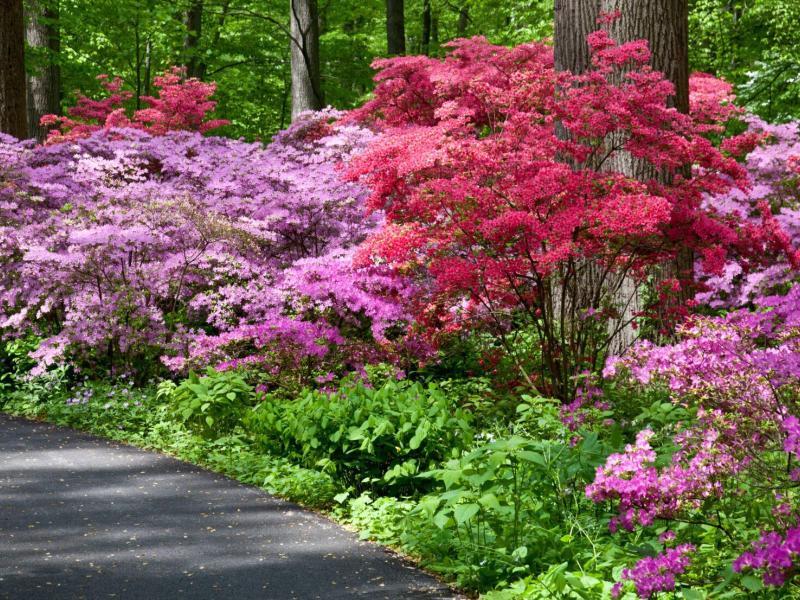
Flowers of azaleas provide most hues (except blue), values, and saturation, so they have a variety of applications for providing color while blooming in a landscape. Color affects the mood of a landscape. Bright, warm colors (i.e., yellows, oranges, and reds) appear to advance toward a viewer and make a garden seem smaller, while cool colors (i.e., greens, blues and violets) appear to recede and make a garden appear larger. Sections of a landscape or garden rooms can have either warm or cool temperature dominance. Brilliant, intense colors are for emphasis and focal points; pale or pastel colors blend and aid in transitions, harmony and unity. Colors dominate through intensity (i.e., the brightest), size (i.e., the largest) or quantity (i.e., the greatest number of plants in an area or mass). Selected azalea cultivars can feature any or all of these attributes. Masses or broad sweeps of one color usually are more effective than dabs or patches of different colors. Masses appear as spontaneous and natural. A dominant color theme with counter points of contrasting colors can create interest and movement. Consider mostly one dominant flower color or analogous colors, with some of another color, and just highlights of a third contrasting color. Evergreen azaleas offer many tints, shades and tones of red, pink, purple and white flowers and a variety of combinations, and deciduous azaleas have yellow, orange, red, pink and white flowers.

Red is energizing and creates impact. Red-flowering plants are best positioned in sun or up close to view points or paths. They are the first to fade in evening light. Examples of good red azaleas are 'Autumn Embers', 'Hershey Red', 'Massasoit', 'Midnight Flare', 'Mother's Day', 'Miss Suzie', 'Red Slippers' and 'Ward's Ruby'. Red, however, covers a huge range of hues, values and saturations, all of which do not match.

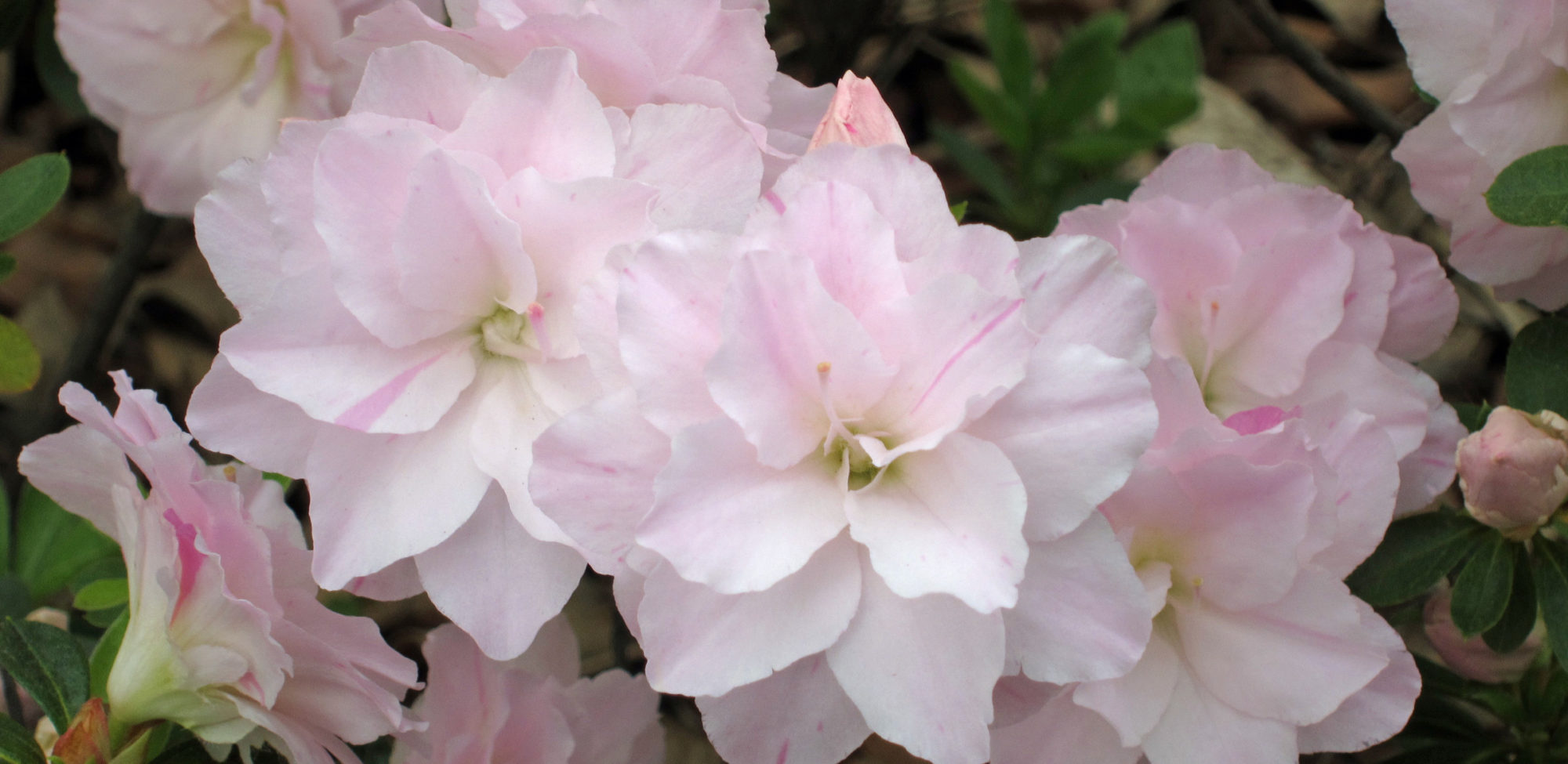
Pink, a tint of red, is probably the most common hue of azaleas. Pink azalea cultivars vary from blush, soft, and pastel tints to deep shades. Examples include 'Coral Bells', 'Glory', 'Nancy of Robinhill', 'Pink Ruffles', 'Rosebud' and 'Wakaebisu.'

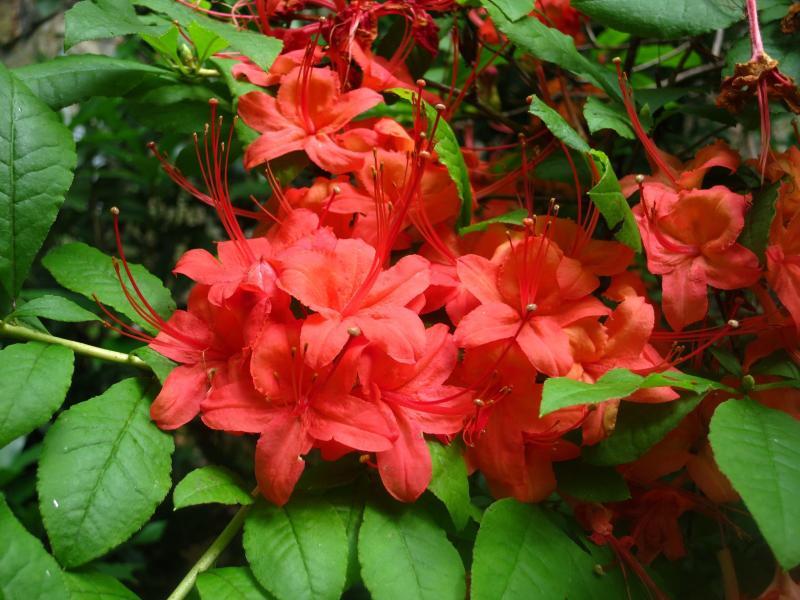
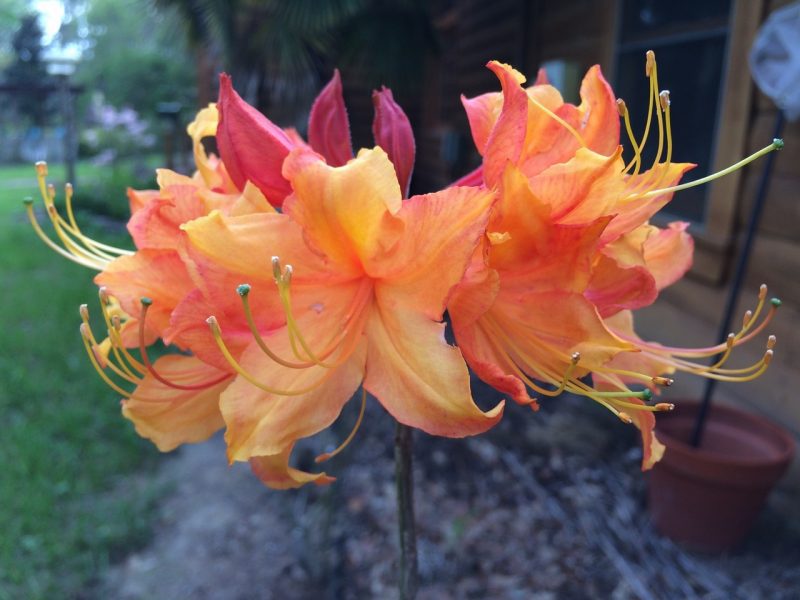
Orange-flowering cultivars often clash with pinks and purplish reds, so plant these in separate locations. Many strains of R. calendulaceum and many deciduous hybrid azaleas are orange (e.g., 'Balzac', 'Gibraltar' and 'Stonewall Jackson'). Evergreen orange azaleas are better described as red-orange rather than the color of the fruit. Examples are 'Flame', 'Orange Cup' and 'Trooper'. Many other cultivars have salmon-colored (yellowish pink) flowers (e.g., 'Ambrosia', 'Louise Gable').

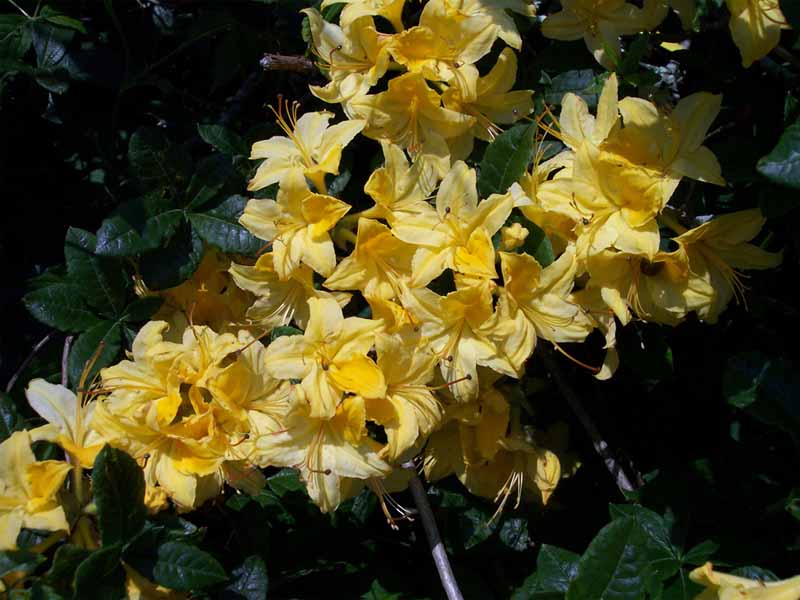
Yellow is the highest valued hue and attracts the eye. It can be seen farther away than other colors. This color can only be found in some deciduous azaleas species (e.g., R. austrinum, R. calendulaceum, R. flammeum) and deciduous cultivars (e.g., 'Admiral Semmes', 'Goldfinch' and 'Pathfinder'.) It harmonizes with most colors.

Purple, throughout history, has been used as a sign of royalty. In garden settings, it gives an effect of receding. Examples of purple azaleas are 'Amoena', 'Easter Morn', 'Girard's Fuchsia', 'Herbert', 'Purple Splendor' and 'Zulu.'

Green dominates in gardens and is easy on the eye. It enhances cool colors and softens hot colors. Lawns near a flower bed rest the eye from colorful flowers. Greens and grays harmonize with most hues. Green, however, is the complement of red and brightens it. Green leaves of azaleas vary somewhat in color, shape and size, but this is not particularly noticeable from a distance. Some azaleas (e.g., 'Silver Streak', 'Silver Sword', and 'Southern Belle') have variegated (green and white) leaves.

White is the most reflective value and, thus, attracts attention. (Next in reflectiveness are warm colors and then the cool colors.) White flowers are seldom pure; they have colored blotches, are often mixed with small amounts of other colors, and they reflect nearby colors. They do not clash with other colors, but may cause distraction when randomly mixed with other colors. White flowers brightens shade and glows at dusk. Examples of white azaleas are 'Autumn Angel', 'Delaware Valley White', 'Dorothy Hayden', 'Georgia Giant', 'H.H. Hume', 'Kate Arendall' and 'Mrs. G.G. Gerbing.' White and neutral-colored flowers contrast with darker colors; darken them, and they can provide transitions from one area or color to another.

Tints and pastel colors glow in shade, evening light and during overcast days, and they brighten gardens under these conditions. There are bicolored azaleas. Many of them feature white centers with margins of red (e.g., 'Fascination', 'Marian Lee'), pink (e.g., 'Painted Tips', 'Parfait', 'Vibrant'), orange (e.g., 'Frosted Orange') or purple (e.g., 'Martha Hitchcock', 'Blue Tip'). Others have variegated colorations with stripes, blotches, sectors and flakes, some with all these arrangements on the same plant. Bicolored flowers work well as transitions. (For information about colors of various azaleas, see text and web sites on azaleas or the CD, "Selecting and Growing Azaleas".)

Color is greatly influenced by light, which varies with weather, climate, season, time of day, direct sunlight, shade, plant foliage and texture. In paintings and landscapes, emphasis can be provided by placing light against dark.

Color schemes in landscapes can vary depending upon the desired effect.
  • A monochromatic scheme incorporates shades, tints and tones of a single hue.
  • An analogous color scheme uses two or three colors that are adjacent to each other on the color wheel (e.g., orange, yellow orange, yellow, yellow green). Analogous colors harmonize. Blending or matching pastel colors in an area gives this effect.
  • A complementary scheme focuses on two colors opposite on the color wheel (i. e., yellow and purple, red and green, blue and orange). Planted together they give lively contrast. For example, red flowers contrast with green leaves and, thus, a spot of red in an otherwise green landscape makes the greens look greener.
  • A triadic scheme uses colors that are equal distances from each other on the color wheel (e.g., green, violet and orange).
  • A polychromatic scheme combines many colors together so that they move fluidly without abrupt transitions.
Restraint of the color palette is a virtue, but challenging for an azalea collector. Color schemes can be changed by combining cultivars that have different bloom times or fall leaf colors. These can present striking views at various times of year. Because different cultivars of azaleas have different bloom times, color impact can be extended or changed by planting early, mid and late blooming cultivars.

Texture   Texture relates to the surface of materials. In landscapes, it is characterized by coarse and fine leaves, flower shape and size, and branch formations. The ability of these features to reflect light (which gives lightness) or absorb light (which gives darkness) or to allow light through influences appearance. Coarse textures present contrasts of light and shadow and impart informal, bold or rustic feelings and give an appearance of advancing. Fine textures appear as smooth and shiny surfaces and have only minute contrasts between light and shade. They impart feelings of elegance, quietude, refinement, neatness and formality, and give the appearance of receding and of distance, making a lot or garden appear larger.

Plants with small numerous leaves (e.g., evergreen azaleas) next to plants with large leaves (e.g., rhododendrons) create contrast. A mix of deciduous and evergreen azaleas also give contrasting textures. The leaves of evergreen azaleas give year-round texture. Deciduous azaleas change shape from summer to winter, providing vertical leaf texture in summer and structure from bare branches and bud forms in winter. Some azalea cultivars have very small leaves (e.g., 'Amoenum', 'Kokinsai'). 'Linearifolium' has long, narrow leaves. 'Nuccio's Mount Baldy' and some other Satsuki azaleas have leaves that are contorted or twisted. The varied size and shaped leaves contrast, but these are not very noticeable from a distance. They tend to give a fine textured appearance. Shadow patterns on pavements, lawns and walls that the sun creates as its light passes through foliage and branches are accents of texture. Texture adds richness, depth and interest to gardens.

Space   Space is a visual element between and around plants. In art it has boundaries and interacts with lines, shapes, colors and textures to give them definition. In gardens, expanses of lawns set off flower beds. There is space around a focal point and between it and its frame. Space comforts the eye and distinguishes plants or beds that are to be noticed.

Time and motion   Time is involved in observers' reaction to a garden. When they walk through a garden or around a plant, the view changes with every elapsed moment. The view presents varied juxtapositions of shape, line, space, texture, light, hues, intensities and values. Changes also occur as the sun moves across the sky and as the seasons change.

There can be actual motion or its illusion. The wind moves leaves, branches and boughs. Fountains and waterfalls provide motion and sound. Curved plantings and repetitive groupings of a specific cultivar give the impression of movement. Alternating different sizes, shapes, colors and textures gradually can also create an illusion of movement. For example, changes can be made from fine to coarse textures, warmer to cooler colors and tints to shades. (See comments under gradation and rhythm for their relation to motion.)

Provide ways to move people through planted areas with paths or lawns between groupings of plants. Paths invite exploration, and as people walk along, there should be mystery of what is ahead or around a bend with resulting serendipity. Sounds of falling or splashing water; changing forms, colors or textures; and fragrance invite exploration. Curved paths tend to make people want to meander, and intersecting lines imply hesitation. Construct wide paths where two persons can walk abreast because narrow paths eventually become tunnels as branches fill in the passage.


  other aspects of landscaping
Certain planting situations call for special planning based upon the landscape theme.

Situation plantings   Plants serve various functions when planted at specific locations. For example, plants put near foundations and corners help anchor a house or other structure, blend vertical walls with the horizontal plane of the ground, and direct attention.

Entrance plantings give a first impression. They invite a viewer to the place of entry, provide transition from surroundings to the yard, garden or home, and give suggestions of what lies beyond.

Place fragrant plants near benches, along paths and near windows. Several deciduous azalea species (e.g., R. alabamense, R. arborescens, R. atlanticum, R. austrinum, R. canescens, R. eastmanii, R. occidentale, R. prinophyllum, R. viscosum) and hybrids from their parentage (e.g., 'My Mary', 'Rosy Cheeks', Snowbird') are fragrant. A few evergreen azaleas (e.g., R. macrosepalum, 'Rose Greeley', 'Lady Locks') are fragrant.

Border plants are used to line or define property boundaries, fences, walkways, driveways and streams; they also direct flow and lead to points of interest. Azaleas of the same variety or those with similar characteristics planted in a line can serve as a hedge or wall.

Screens or groupings of plants can be used to hide unwanted views or objects (e.g., trash cans, neighboring houses or streets). To be effective, they should be at least 6 feet tall.

Strategically placed trees can filter light or create shade for shade-loving plants, and they lower temperatures of a patio or seating-area. Azaleas grow well in these locations.

Consider several "enclosed" areas or garden rooms, as there are different rooms in a house. Rooms make a garden appear larger. Each room can have its own purpose, color schemes, and special features. It can be formal or informal. The rooms can vary in size, and each should have easy access, enclosures or borders, and a focal point or activity focus. Floors can be lawn, ground cover or flat-stone materials. Ceilings are the sky, tree canopy, or an arbor. Walls separate rooms and are formed by tall growing plants, hedges, fences or sides of buildings. The rooms can be separated by driveways, paths, lawns or borders. Principles and elements of design apply to each room with consideration of transitions between them and overall unity. Have places to sit to enjoy a garden or room.

Theme   Themes for a landscape or a garden vary. They can, for example, aim to
  • create interest in a specific location,
  • generate a sense of awe and impress, dazzle and stimulate viewers,
  • be a place for relaxing, quieting and contemplation,
  • enhance the house and other structures,
  • fit in with the predominate natural flora,
  • be a place to entertain or play, or
  • collect plants of different species or cultivars of the same species.
The lot and structures on it may influence themes. For example, wooded lots and modern houses are best suited to informal naturalistic arrangements; colonial houses are complemented by a formal, symmetrical presentation. There can be whimsy elements to add humor and surprise in a garden. Themes are established by arrangements of plants, color schemes and structures.

Azaleas are often used in Southern, Japanese, Chinese, woodland, rock, butterfly, and hummingbird gardens. They are used in single species gardens or when a variety of plants of a single color (e.g., white or moon, pink, red) are desired. Deciduous species and cultivars of azaleas can be used in fragrant gardens. Evergreen and deciduous azaleas mixed with rhododendrons, camellia and mountain laurel are natural in wooded lots where trees provide light shade. Varieties of azaleas can be chosen that bloom from early spring to fall. Rhododendrons and mountain laurels bloom mid season; japonica camellias bloom in early spring and sasanqua camellias in fall. The azaleas can be planted in drifts where paths wander through the mass. It's your choice!

Learning and keeping abreast   Get books on azaleas and landscaping, scan web sites for these topics, visit gardens, and participate in a local azalea chapter to learn more about these versatile and beautiful shrubs and their placement and cultivation in yards and gardens. Apply what you learn!

The author, Frank Bryan, is not trained in landscaping. Knowledge of the subject comes from visiting national and international art museums of renown, reading books and articles on art and landscaping, having hobbies of photography and painting, and placing plants where his wife, Ruth, suggests. Dr. Bryan is editor of the Oconee Chapter, Azalea Society of America, Newsletter.
previous   1   2

  related pages
azaleas
Updated July 12, 2007

Home | About Us | Join Us | Conventions | Research | | Azaleas | FAQ | Pictures | Ask Us | Archives | Sources | Seed | | Links | Gardens | Online Store | The Azalean | Azalea City | | Site Map | What's New
© Copyright 1999-2010 Azalea Society of America
Questions/Comments: webmaster@azaleas.org
  .